Driven by the global “dual-carbon” goal, electric motors, as the core power source for industrial production, transportation and daily life, are accelerating towards high efficiency, miniaturization and intelligence. As the core material of the motor winding, the performance of enameled copper wire directly determines the efficiency, life and reliability of the motor. From household air-conditioning motors to new energy vehicles 800V high-voltage drive motors, from industrial compressors to aerospace special motors, enameled copper wire with “conductive + insulating” integration of advantages, to promote the upgrading of the motor industry has become a key material.
what is enameled copper wire?
Enameled copper wire refers to the surface of the high-purity electrolytic copper conductor, through a special process of coating a very thin and uniform layer of insulating varnish (industry commonly known as “lacquer layer”) formed by the special wire, is the core material of electromagnetic equipment winding. Its original design intent is to maximize the retention of copper’s excellent electrical conductivity on the basis of insulating coatings to completely solve the winding short-circuit problems, while taking into account the ease of installation and long-term reliability.
Compared with traditional bare copper wire and yarn-wrapped wire, enameled copper wire has three core features:
Structural integration: the conductor (high purity copper) and the insulation layer (enameled layer) form an inseparable whole, avoiding the insulation layer from falling off or shifting;
Installation convenience: no need to scrape the insulation layer can be directly welded, especially polyester nylon coated products can realize non-stripping welding, greatly simplifying the motor assembly process;
Performance composite: not only to retain the high conductivity of copper, corrosion resistance, but also through the paint layer to achieve insulation, high temperature resistance, wear resistance and other functions, to meet the needs of the motor multi-scenario operation.
From the perspective of material composition, the quality of enameled copper wire depends on two core elements:
Conductor material: Electrolytic copper with purity ≥99.97% and conductivity ≥58×10^6 S/m is used to ensure current transfer efficiency; oxygen-free copper is used in some high-end products to further reduce the content of impurities and improve conductivity and corrosion resistance.
Insulating varnish layer: According to different application scenarios, different materials such as polyester (PEW), polyesterimide (EIW), polyimide (PAI), Nomex, Kapton, etc., are selected to form a full temperature level coverage from 130℃ to 240℃, and at the same time, it has the characteristics of abrasion-resistant, corona-resistant, and chemical corrosion-resistant.
Why enameled copper wire is preferred for motors?
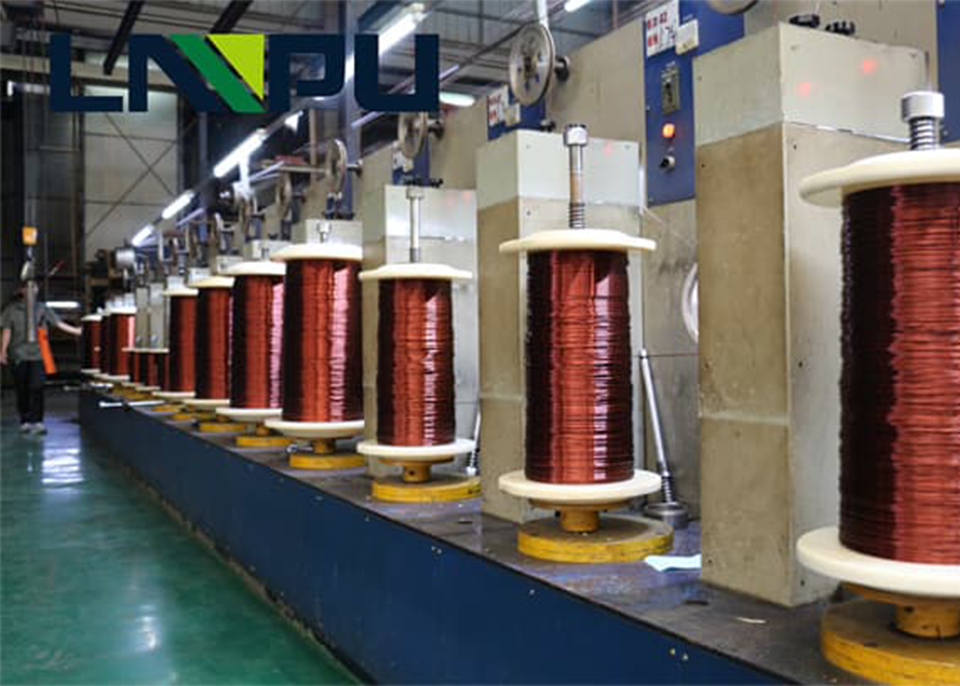
During the operation of the motor, the windings are subjected to multiple severe tests: mechanical vibration brought about by continuous high-speed rotation, Joule heat generated by the passage of electric current (temperatures of up to 100 ℃ -200 ℃), humidity and dust erosion in the environment, as well as friction and abrasion during assembly and operation. Conventional wires (e.g., bare copper, aluminum, and yarn-coated wires) have many pain points: bare copper wires are prone to short circuits, aluminum wires have low conductivity and are prone to oxidation, and yarn-coated wires are prone to breakage of the insulation layer and are complicated to install.
Insulation paint layer
The motor winding consists of thousands or even tens of thousands of turns of wires wound tightly, and the distance between the wires is only micron level, once the insulation fails, turn-to-turn short-circuits will easily occur, leading to motor burnout. The special enamel layer of enameled copper wire forms a dense insulating barrier with a breakdown voltage of 15kV/mm or more, which can effectively isolate the current conduction of neighboring wires. Especially in new energy vehicle 800V high voltage platform, industrial motor high frequency start and stop scenarios, the corona and breakdown resistance of the insulating varnish layer is the key to ensure the safe operation of the motor.
High Conductivity
Motor loss mainly includes copper consumption (winding loss), iron consumption (core loss), mechanical loss and stray loss, of which copper consumption accounts for as high as 65%, which is the core factor affecting the efficiency of the motor. The conductivity of copper is more than 1.6 times that of aluminum, and its resistance is only 62% of aluminum. Under the same cross-sectional area, the copper consumption of enameled copper wire is 38% lower than that of aluminum wire.
Extended durability
The service life of the motor is directly related to the reliability of the winding. The enamel layer of enameled copper wire has excellent mechanical strength, and the abrasion resistance reaches 100 times of reciprocating friction without breakage (GB/T 4074 standard), which can resist vibration and friction in the operation of the motor; the copper substrate itself has the natural corrosion-resistant ability, and with the protection of the enamel layer, it can be operated for a long period of time in the environment of – 40℃-200℃ and humidity ≤ 95%, avoiding oxidation and aging of the wires.
The flexibility and easy welding characteristics of enameled copper wire also solves the “installation problem” in motor assembly: even in the narrow space of small motors, it can be easily wound into complex coil shapes; the standard welding process is adapted to automated production lines, and the assembly efficiency is more than 30% higher than that of traditional wires, which is especially suitable for new energy automobile motors and other It is especially suitable for new energy automobile motors and other large-scale mass production scenarios.
Advantages of enameled copper wire
Excellent conductivity, double the energy efficiency
Low resistance loss: under the same cross-sectional area, the resistance of copper is only 62% of that of aluminum, which can reduce the Joule heat loss in the process of current transmission and lower the temperature rise of the motor;
High current density: the current-carrying capacity of copper can reach 3-5 A/mm², which is higher than that of aluminum’s 2-3 A/mm², and the cross-sectional area of the wire can be reduced under the same power, saving the winding space;
Significant improvement in energy efficiency: according to GB 18613-2020 “Motor Energy Efficiency Limit Values and Energy Efficiency Classes”, motors with enameled copper wires are more likely to reach IE4 (ultra-high efficiency), while most of the motors with aluminum wires can only reach IE2-IE3.
Precise insulation protection, safe and worry-free
High breakdown voltage: the thickness of the enamel layer is only 0.03-0.15mm, but the breakdown voltage can reach 10-30kV, which can effectively resist the transient over-voltage during the operation of the motor;
Strong insulation stability: at rated temperature, the insulation resistance of the paint layer remains above 10^12 Ω, and there is no obvious attenuation in long-term operation.
High temperature resistance, adapt to extreme working conditions
130℃-155℃ (polyester PEW): suitable for household air conditioners, refrigerators, fans and other common household appliances motors, low operating temperature and stable working conditions;
180 ℃ (polyester imide EIW): for industrial compressors, pumps, machine tool motors and other long-term heavy-duty equipment, can withstand sustained high temperatures;
200℃-220℃ (polyimide PAI): suitable for new energy automobile drive motors, aerospace special motors, to maintain stable performance in high temperature and high pressure environment;
240℃ (full PAI coating): applicable to sealing motors, defense equipment motors and other extreme conditions, capable of continuous operation for more than 10,000 hours at a high temperature of 240℃.
The enameled copper wire has excellent thermal shock performance, after 100 cycles of shock from – 40℃ to rated temperature, there is no cracking or peeling off of the lacquer layer, which can adapt to harsh environments with alternating high and low temperatures, such as outdoor wind generators, cold-chain transportation refrigeration motors and so on.
Ultra-thin insulation layer for compact design
Enhancement of slot filling rate: the slot filling rate of motor stator is a key factor affecting power density, the ultra-thin layer of enameled copper wire can reduce the space occupied by insulation material, so that the filling ratio of copper material can be increased significantly.
Optimize the structure of the motor: after the slot filling rate is increased, the same volume of the motor can output higher power, or the same power of the motor volume is greatly reduced. Taking new energy vehicle drive motors as an example, the volume of motors with flat enameled copper wires is 15%-20% smaller than round wire motors, and the weight is reduced by 20%-25%, which helps to improve the vehicle range.
Superior durability and lower maintenance costs
High mechanical strength: the tensile strength of the enameled layer is ≥15 MPa, and the elongation at break is ≥20%, which can withstand the bending and tensile stresses in motor assembly and operation;
Excellent abrasion resistance: according to GB/T 4074.2 standard test, the paint layer is not broken after 100 times of reciprocating friction (load 1N), which is much higher than the industry average of 50 times;
Strong aging resistance: after 1000 hours of aging at a high temperature of 150℃, the insulation resistance of the paint layer is maintained at ≥80%, and there is no significant drop in breakdown voltage.
Good flexibility, suitable for complex installation
Good bending performance: the minimum bending radius is only 5-8 times of the wire diameter, it can be easily wound into a variety of complex coil shapes, suitable for small motors, precision instruments and other space-constrained scenarios;
High winding efficiency: the flexible enameled copper wire can be adapted to high-speed winding machines (winding speed up to 1000 m/min), increasing productivity by more than 40% compared with rigid wires;
Convenient installation: In the complex structure of motor stator and rotor, the flexible enameled copper wire can easily pass through the narrow channel, reducing wire damage during installation.
For example, in a micro gear motor with a diameter of only 50mm, the ultra-fine enameled copper wire with a diameter of Φ0.1mm can be wound more than 10,000 turns without any lacquer layer breakage, ensuring the normal operation of the motor.
Anti-corrosion characteristics, prolonging service life
Resistant to humidity corrosion: placed in the environment of 95% humidity and 40℃ for 1000 hours, the thickness of conductor oxidized layer is ≤0.005mm, without obvious corrosion phenomenon;
Chemical corrosion resistance: it can resist the erosion of oil, acid and alkali mist in the industrial environment, applicable to chemical pumps, marine ship motors and other scenarios;
Salt spray corrosion resistance: after 500 hours of salt spray test (GB/T 2423.17), the paint layer has no blistering, peeling, and the conductor has no rusting, which can meet the needs of offshore wind power, ship motors and other marine environment applications.
Compatible with standard welding, easy assembly
No stripping welding: polyester nylon coating and other weldable enameled wire, at 260-300 ℃ welding temperature, the paint layer will melt and evaporate by itself, without the need to peel off in advance, simplifying the welding process;
High welding reliability: excellent welding performance of copper, can be soldered by tin welding, silver welding, argon arc welding and other welding methods, high strength of the welded joints, low resistance, long-term operation without heating, shedding phenomenon;
Suitable for automated production: the standard welding process can be integrated into the automated production line for motors, with a welding efficiency of 1,000 points/hour, much higher than the manual welding of traditional wires (200 points/hour), which reduces the labor cost and welding defect rate.
the main categories and application scenarios of copper enameled wire for electric motors
- Polyester enameled copper wire (PEW, 130℃/155℃)
Core features: cost-effective, stable insulation performance, good solvent resistance, is the preferred material for general-purpose motors;
Applicable scenarios: motors for household appliances such as household air conditioners, refrigerators, washing machines, fans, etc., small power transformers, and traditional HVAC system motors;
Typical parameters: breakdown voltage ≥15kV/mm, tensile strength ≥12MPa, temperature resistance class 130℃ (Class B)/155℃ (Class F);
2. Polyester nylon solderable enameled copper wire (155℃)
Core features: smooth surface, good thermal shock performance, non-stripping welding, suitable for automated production lines;
Applicable scenarios: small industrial motors, automotive auxiliary motors (e.g. window, wiper motors), electronic equipment micro-motors;
Typical parameters: welding temperature 280℃, thermal shock (155℃×30min) without cracking, breakdown voltage ≥18kV/mm;
Core advantages: high – speed mechanical winding without wire stripping, automated assembly efficiency increased by 50%.
3. Polyester-imide enameled copper wire (EIW, 180℃)
Core features: high temperature resistance, high mechanical strength, good hydrolysis resistance, suitable for long-term heavy load operation;
Applicable scenarios: industrial compressors, water pumps, machine tool motors, power tool motors, refrigeration compressor motors;
Typical parameters: temperature resistance class 180℃ (Class H), hydrolysis stability (120℃×1000h) insulation resistance ≥10^10 Ω, breakdown voltage ≥20kV/mm;
Core advantage: 2 times longer service life than ordinary enameled wire in humid industrial environment.
4. Polyimide coated enameled copper wire (200℃/220℃)
Core features: ultra-high temperature resistance, excellent mechanical strength, chemical resistance, suitable for extreme working conditions;
Applicable scenarios: new energy vehicle drive motors, aerospace special motors, high temperature fan motors;
Typical parameters: temperature resistance class 200℃-220℃ (Class C), tensile strength ≥18MPa, resistance to refrigerant and solvent corrosion;
Core advantage: 10000 hours of continuous operation at high temperature of 200℃, no attenuation of insulation performance.
5. full polyimide enameled copper wire (PAI, 220℃/240℃)
Core features: Highest temperature resistance level, optimal mechanical durability, high overload resistance;
Applicable scenarios: sealed motors, defense equipment motors, extreme overload motors, nuclear industry motors;
Typical parameters: temperature resistance class 220℃-240℃, breakdown voltage ≥30kV/mm, radiation dose resistance ≥10^6 Gy;
6 corona enameled copper wire
Core features: corona discharge resistance, high-frequency voltage shock resistance, suitable for high-voltage and high-frequency motors;
Applicable scenarios: new energy vehicle drive motors, variable frequency motors (VFD), high-voltage transformers;
Technical highlights: Inorganic nanoparticles are added to the insulation layer, which can inhibit ozone erosion caused by corona discharge and extend the service life by more than 3 times than ordinary enameled wires;
Typical applications: Tesla Model 3/Y drive motors, BYD Han EV high-voltage motors.
7. Self-adhesive enameled copper wire
Core features: heat-activated self-bonding, no additional adhesive required, stable coil structure;
Applicable scenarios: small transformers, inductor coils, micro-motor windings;
Core advantage: self-bonding by heating (120-150℃) after winding, forming rigid coil structure, strong vibration resistance, eliminating the need for paint dipping process;
Production efficiency: 40% shorter coil manufacturing cycle and 20% lower production cost.
8. Flat (rectangular) enameled copper wire
Core features: high slot fullness, good heat dissipation performance, high power density, is the mainstream choice for new energy motors;
Applicable scenarios: new energy vehicle traction motors, high-power industrial motors, high-speed railroad traction motors;
Typical parameters: cross-section size 0.8×2.0mm-3.0×6.0mm, slot fullness up to 70%-80%, heat dissipation coefficient 30% higher than round wire;
Technology trend: With the popularization of 800V high-voltage platform, flat wire enameled copper wire is developed in the direction of thinner and wider to further improve the slot filling rate.
9. Triple insulation enameled copper wire
Core features: triple insulation structure, high resistance to electric breakdown and high safety;
Applicable scenarios: high-voltage motors, power transformers, medical equipment motors;
Typical parameters: insulation thickness 0.15-0.3mm, breakdown voltage ≥40kV, temperature resistance class 155℃;
Core advantages: no need for additional insulation measures, direct access to metal parts, simplified motor structure.
10. Special insulated enameled copper wires (Kapton/Nomex)
Kapton insulated enameled wire: insulated with polyimide film, temperature resistant 260°C, chemical and radiation resistant, suitable for aerospace and nuclear industry motors;
Nomex insulated enameled wire: insulated with aramid paper, flame retardant, high temperature resistant 180°C, suitable for fire fighting equipment motors, high temperature fan motors;
Typical applications: Boeing 787 airliner auxiliary motors, DuPont new energy vehicle drive motor insulation solutions.
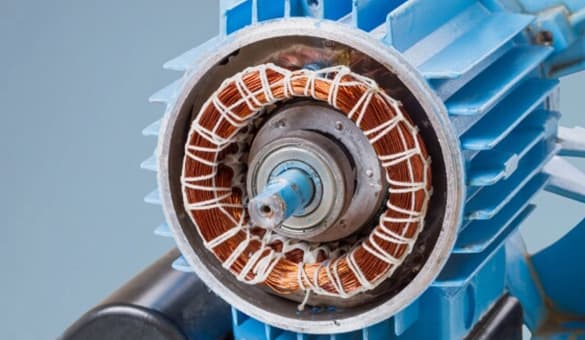
Core application scenarios of enameled copper wire in motors
- Industrial motor field
Industrial motors are important application scenarios of enameled copper wire, covering machine tools, pumps, compressors and other equipment. The core demand for copper enameled wire in this field is high durability, high efficiency and low maintenance costs, polyesterimide (EIW, 180 ℃), polyimide (PAI, 200 ℃) enameled copper wire is the mainstream choice.
- New energy automobile field
In new energy vehicle drive motors, generators and other components, copper enameled wire needs to meet the high power density, high temperature resistance, corona resistance and other stringent requirements, flat wire enameled copper wire, corona-resistant enameled copper wire is widely used.
- Household appliances
Household appliances such as air conditioners, refrigerators, washing machines, motors use a lot of enameled copper wire, the pursuit of low-cost, high-efficiency and quiet operation. Polyester (PEW, 130℃/155℃), polyester nylon solderable enameled copper wire is the main category.
- Renewable energy field
Wind power, solar energy and other renewable energy equipment requires high weather resistance and corrosion resistance of enameled copper wire. Salt spray enameled copper wire, high temperature resistant polyimide enameled copper wire is a common choice.
- 5. Medical equipment field
Medical imaging, respiratory equipment such as motors, copper enameled wire low noise, high precision and high safety. Triple insulated enameled copper wire, ultra-fine enameled copper wire (wire diameter 0.01-0.1mm) is more widely used, need to achieve insulation resistance ≥ 10 ^ 13 Ω, noise ≤ 30dB and other parameters, in line with ISO 13485 medical equipment standards.
enameled copper wire for motor procurement selection guide
1. Define the core parameters
Motor load: heavy-duty motors (such as compressors, machine tools) need to choose thick gauge, high mechanical strength enameled wire (such as EIW, PAI); light-duty motors (such as fans, micro-motors) can choose thin gauge, low-cost PEW enameled wire;
Working temperature: According to the rated temperature rise of the motor, choose the product with insulation level 10-20℃ higher than the actual working temperature. For example, for a motor with an operating temperature of 120°C, choose enameled wire with a rating of 130°C (Class B) and above;
Speed and vibration: High-speed motors (speed > 3000rpm) need to choose products with good flexibility and strong adhesion of the paint layer, so as to avoid vibration leading to peeling off of the paint layer;
Installation space: for motors with limited space (e.g. new energy vehicle drive motors), flat wire enameled copper wire is preferred to improve the slot filling rate; round wire enameled wire can be selected for standard scenarios to reduce costs.
2. Preferred conductor material
Priority: high-purity electrolytic copper (purity ≥ 99.97%), oxygen-free copper conductor, conductivity ≥ 58 × 10 ^ 6 S/m;
Firmly avoid: copper clad aluminum (CCA), low purity copper conductor, this kind of material conductivity is low (only 60% of pure copper), easy to oxidize, will lead to motor efficiency decline, shorten life;
Verification methods: require suppliers to provide copper purity test reports (such as ICP-MS testing), conductivity test reports, to ensure compliance with GB/T 4074.2 standards.
3. Matching wire gauge and shape
Selection of wire gauge: Calculate the cross-section area of the wire according to the rated current of the motor, the formula is S=I/J (S is the cross-section area, I is the rated current, J is the current density, and the copper wire J is 3-5 A/mm²);
Shape selection:
Ordinary motors: round wire enameled copper wire, low processing costs and high versatility;
High power density motors: flat wire enameled copper wire, high slot fullness, good heat dissipation;
Micro motors: ultra-fine round wire enameled copper wire (wire diameter), suitable for compact structures;
Note: too fine wire gauge will lead to increased copper consumption and high motor temperature rise; too thick wire gauge will increase cost and reduce slot fullness, need to be accurately matched.
4. Lock insulation level
Match the insulation material:
Home appliance motor: polyester (PEW, 130℃/155℃), cost optimization;
Industrial motors: polyester imide (EIW, 180℃), good temperature and weather resistance;
New energy motors: Polyimide (PAI, 200℃/220℃) + corona resistant coating, suitable for high voltage and high frequency scenarios;
Specialty motors: Kapton/Nomex insulation to meet extreme temperature and flame retardant requirements;
Key index verification: breakdown voltage (≥15kV/mm), insulation resistance (≥10^12 Ω), thermal aging performance (no degradation for 1000 hours at rated temperature).
5. Verification of supplier qualifications
Core qualification requirements:
Industry certification: UL certification (North American market), IEC certification (worldwide), ISO 9001 quality management system certification;
Product standards: GB/T 4074 (China), IEC 60317 (international), NEMA MW 1000 (U.S.) standards;
Test reports: copper purity, electrical conductivity, breakdown voltage, temperature resistance, abrasion resistance and other third-party test reports;
Preferred suppliers: Jiang Copper, Tongling Jingda, Jinbei Electric, DuPont (Nomex/Kapton) and other companies with core technology and stable production capacity, to avoid choosing small workshop suppliers, whose products may have problems such as paint peeling off, conductivity does not meet the standards.
6. Prototype testing to ensure adaptability
Test items:
Electrical performance: motor efficiency, power factor, copper consumption, temperature rise;
Reliability: thermal aging test (rated temperature × 1000 hours), vibration test (10-2000Hz), salt spray test (500 hours);
Process adaptation: welding reliability, winding processability, assembly convenience;
Decision-making basis: prototype test results need to meet the motor design indicators, such as efficiency to reach the target level, temperature rise ≤ 80K, trouble-free operation ≥ 1,000 hours, before bulk purchases.
Industry Trends
With the rapid development of new energy vehicles, high-efficiency industrial motors, renewable energy and other fields, the enameled copper wire industry is upgrading in the direction of high temperature resistance, refinement, customization, environmental protection
1. High temperature resistance and high performance become mainstream
Temperature grade improvement: with the increase of motor power density, the working temperature continues to rise, 200 ℃ -220 ℃ polyimide enameled wire market share will increase from the current 15% to 35% in 2030;
Functional composite: demand for multifunctional integrated enamel wires such as corona-resistant, corrosion-resistant and flame-retardant is growing, especially in the scenarios of new energy automobile 800V high-voltage platforms and industrial inverter motors, corona-resistant enamel wires will become the standard;
Material innovation: the application of new insulating materials (such as PEEK, polyetherimide) will further enhance the temperature resistance and mechanical properties of enameled wire, breaking through the temperature limit of over 240℃.
2 flat wire enameled wire to accelerate the replacement of round wire
Market demand growth: new energy vehicle drive motors, high-power industrial motors for power density requirements continue to improve, flat wire enameled wire market size will expand at an annual growth rate of 30%, 2030 will account for 40%;
Direction of technological upgrading: flat wire enameled wire to “thinner, wider, higher precision” development, cross-section size tolerance control within ±0.01mm, in order to further enhance the slot full rate;
Production process optimization: the application of automated production lines, such as continuous annealing, precision coating and online inspection, will improve the production efficiency and product consistency of flat wire enameled wire.
3. Environmentalization and sustainable development
Application of environmentally friendly materials: lead-free, halogen-free, low VOC (volatile organic compounds) insulating varnish will become the mainstream, in line with global environmental policy requirements;
Recycling enhancement: the recycling rate of copper will increase from the current 75% to 85% by 2030, and the market share of recycled copper enameled wire will reach 25%, reducing resource consumption;
Energy-saving production process: adopting energy-saving coating equipment, waste heat recovery system, etc. to reduce energy consumption in the production process of enameled wire and realize green development of the whole industrial chain.
4. Customized service becomes the core of competition
Growth of personalized demand: different industries, different motors work in different scenarios, increasing demand for personalized wire gauge, shape, insulation material, performance indicators of enameled wire;
Upgrading of supplier services: head enterprises will provide integrated services of “customized R&D + precise matching + technical support”, such as optimizing enameled wire specifications according to motor design parameters, providing prototype testing and process improvement suggestions;
Industry chain innovation: enameled wire enterprises and motor manufacturers, vehicle manufacturers, in-depth cooperation, joint research and development of special enameled wire to adapt to specific scenarios, such as new energy vehicles, 800V high-voltage platform special corona-resistant flat wire, aerospace special motors special Kapton insulated enameled wire.
Conclusion
As the “power heart” of the motor, the performance of enameled copper wire directly determines the efficiency, life and reliability of the motor. In the context of global energy transition and industrial upgrading, motors as the core power equipment, the performance requirements of copper enameled wire are constantly increasing. From household air-conditioning motors to new energy vehicle drive motors, from industrial compressors to aerospace special motors, high-quality enameled copper wires are becoming the key material to promote the motor industry to high efficiency, miniaturization and intelligent development with its excellent electrical conductivity, reliable insulation and protection, super durability, and a wide range of adaptability.
For motor manufacturers and buyers, the choice of high-quality enameled copper wire not only enhances product competitiveness, but also reduces the whole life cycle costs, realizing a win-win situation in terms of economic and social benefits. In the future, with the continuous innovation and application of high-temperature resistant, high-performance and environmentally friendly enameled wires, enameled copper wires will play a central role in more emerging fields, providing a strong impetus for the realization of the global “dual-carbon” goal and the progress of industrial civilization.