In the rapid development of the electric motor industry, the motor winding wire as the “heart of the motor”, its selection of reasonable directly determine the operating efficiency, service life, safety and stability of the motor, but also affect the overall performance of the entire equipment and the level of energy consumption.
Whether it is motor manufacturing, equipment maintenance, or engineering upgrades, the correct choice of motor winding wire is to reduce production costs and enhance product competitiveness of the key links.
Introduction to motor winding wire
Motor winding wire, also known as motor winding wire, electromagnetic wire, is specially used for winding motor winding insulated conductive wire, its core function is to generate a stable electromagnetic field through the passage of electric current, and then drive the motor rotor rotation, to achieve high efficiency conversion of electrical energy to mechanical energy, is the core of all the indispensable electric motor components.
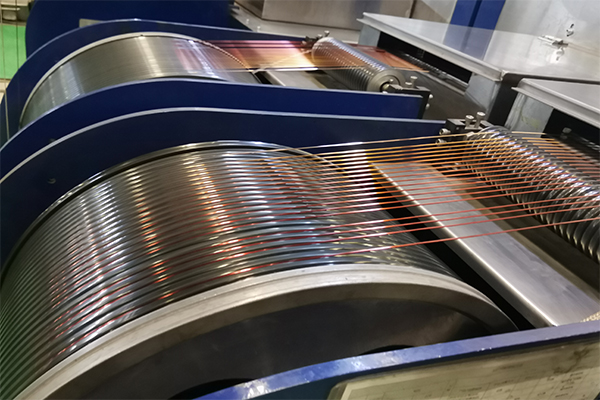
The core performance index of winding wire directly determines the overall performance of the motor, in which the conductivity determines the high and low energy loss of the motor, the heat resistance determines the upper limit of the motor’s operating temperature, the insulation determines the safety of the motor’s operation, and the mechanical strength determines the winding wire’s resistance to abrasion, tensile strength, and ability to adapt to the complex working conditions.
Classification of motor winding
Motor winding is a specific application of winding wire, its structure and classification directly affect the motor’s mode of operation, power output and efficiency level. The classification of motor winding is mainly based on two core dimensions:
The structural position of the winding in the motor, the functional division of the winding in the motor, the two types of classification are interrelated and synergistic, and together determine the core performance of the motor.
Classification according to structural position
Stator winding and rotor winding
Stator winding and rotor winding is the most basic classification of motor winding, their installation position, function and clear division of labor, work together to form the electromagnetic field driving motor operation, is the core component of all rotating motors.
The stator winding is installed on the fixed part of the motor (i.e. stator), which is the core component of the motor to generate the rotating magnetic field. When the stator winding is energized with AC current, it generates a rotating magnetic field that varies periodically, providing a power base for the rotation of the motor rotor.
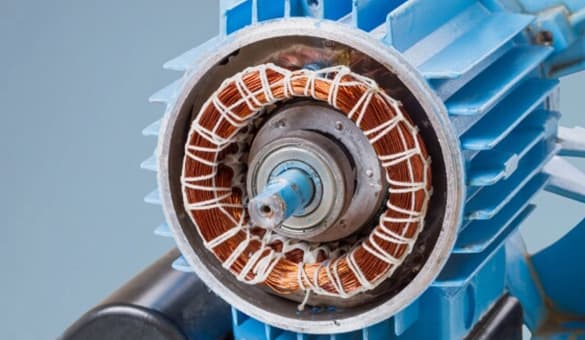
The stator winding is widely used in mainstream motors such as AC induction motors, synchronous motors, brushless DC motors (BLDC motors), etc. The rationality of its winding structure directly affects the uniformity of the magnetic field distribution and motor efficiency.
In AC induction motors, the rotor winding generates induction current through electromagnetic induction, which interacts with the rotating magnetic field generated by the stator winding to generate electromagnetic torque and drive the rotor;
In synchronous motors, the rotor winding receives DC excitation current directly and generates a fixed magnetic field, which is in synchronization with the rotating magnetic field of the stator and ensures a stable output speed of the motor.
Classification by function
Armature winding and excitation winding
According to functional classification, the motor winding can be divided into armature winding and excitation winding, the core of the two are clearly divided, respectively responsible for energy conversion and magnetic field generation, and its reasonable design directly determines the energy conversion efficiency and power output stability of the motor.
The core function of the armature winding is to carry the current, interact with the magnetic field inside the motor, and realize the two-way conversion of electric energy and mechanical energy – when the motor is running, the electric energy is converted into mechanical energy; when the generator is running, the mechanical energy is converted into electric energy.
Armature windings are mainly used in DC motors, synchronous motors and generators, and their structure is usually divided into two configurations: stack winding and wave winding.
Stacked winding adopts the way of overlapping connection of multiple coils to form multiple parallel current paths, which has the advantages of strong current-carrying capacity and good heat dissipation, and is suitable for high-current and low-voltage scenarios, such as industrial DC motors, traction motors, etc.
Wave winding adopts the way of series connection to form a single continuous current path, which has the advantages of strong voltage-carrying capacity and compact structure, and is suitable for high-voltage and low-current scenarios, such as large-scale synchronous generators and high-voltage motors. synchronous generators, high-voltage motors, etc.
The core function of the excitation winding is to generate and maintain a stable magnetic field required for motor operation, and its excitation is mainly divided into two types: independent excitation and self-excitation.
Independent excitation means that the excitation winding is powered by an external independent power supply with stable magnetic field strength, which is suitable for scenarios with high requirements for speed and torque control; self-excitation means that the excitation winding is connected to the armature circuit and relies on the motor’s own current to realize excitation, which is simple in structure and low in cost, and is suitable for ordinary industrial motors and household motors.
In addition, in permanent magnet motors, the excitation winding is replaced by permanent magnets, without external excitation power supply, which simplifies the structure of the motor, reduces energy consumption and maintenance costs, and is now widely used in new energy vehicles, small household appliances and other fields.
Motor Winding Materials
Winding wire material is to determine the core performance (conductivity, density, cost, mechanical strength) of the key, the industry’s mainstream motor winding wire materials are mainly copper, aluminum, different materials, performance differences are significant, adaptable to different scenarios.
When selecting the type, it is necessary to combine the performance requirements of the motor, cost budget, application scenarios (such as weight limit, temperature requirements) and other factors to avoid blind selection.
Copper–the mainstream preferred material
Copper is currently the most widely used motor winding line material, , its core advantage lies in the excellent electrical conductivity and chemical stability. Copper can effectively reduce the energy loss during the operation of the motor, reduce the heating of the winding wire, and improve the operating efficiency and stability of the motor.
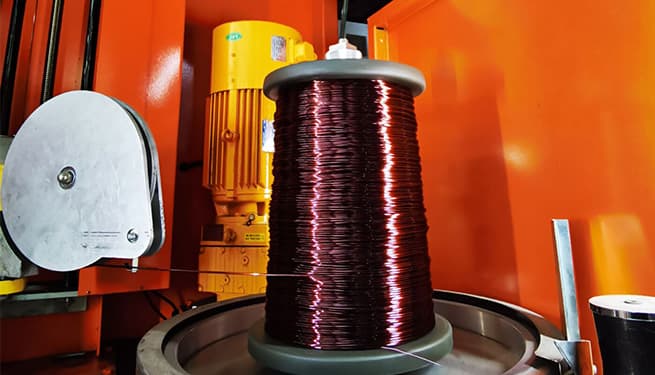
In practice, in order to prevent short circuits between the winding wires and extend the service life of the winding wires, a thin layer of insulating varnish is usually applied on the surface of the copper wires to form enameled copper wires, which is also the mainstream form of motor winding wires at present. Enameled copper wire not only retains the excellent electrical conductivity of copper, but also has good insulation properties, suitable for most motor scenarios.
Aluminum–lightweight and economical materials
Aluminum is the main alternative material to copper, about one-third of copper, is the ideal choice for lightweight scenarios. In new energy vehicles, aerospace, portable devices and other areas with stringent weight requirements, aluminum winding wire can effectively reduce the weight of the motor and improve the range and portability of the device, while reducing material costs.
However, the conductivity of aluminum is lower than copper, in order to achieve the same conductivity and power output with copper winding wire, you need to use a larger cross-section of aluminum wire, which will lead to the volume of the aluminum winding is larger than the copper winding, the miniaturization of the design of the motor has a certain impact.
In addition, the mechanical strength of aluminum is slightly inferior to copper, in the winding process is prone to breakage, wear and tear and other problems, the need to optimize the winding process.
Thanks to the continuous upgrading of aluminum alloy technology, the performance of aluminum winding wire has been gradually optimized, and its application is becoming more and more widespread in cost-sensitive and weight-prioritized scenarios, such as household air conditioners, refrigeration units, and general industrial motors.
Key Factors in Selecting Motor Winding Wire
Selection of motor winding wire, can not simply rely on the material or type, need to be combined with the motor’s operating environment, performance requirements, cost budgets, winding structure and other factors to consider in order to select the most suitable winding wire, to ensure that the motor is efficient, stable, long life operation. The following are the core factors to focus on in the selection process, but also industry practitioners are most likely to ignore the key points.
Motor operating environment
The operating environment is the primary consideration of the winding line selection, different environments on the winding line insulation, heat resistance, corrosion resistance, moisture resistance requirements vary significantly, directly determining the service life of the winding line and operational stability.
High-temperature environments (such as industrial furnace, new energy vehicle drive motors, aerospace equipment), you need to choose a high level of heat-resistant winding wire, such as silicone coated wire, polyimide enameled wire, polyester imide enameled wire;
Humid, dusty environments (such as outdoor equipment, mining machinery), you need to choose the moisture-proof, dust-proof performance of the insulated In humid and dusty environments (such as outdoor equipment and mining machinery), it is necessary to choose insulated wire with moisture-proof and dust-proof properties, such as polyamideimide enameled wire and glass fiber insulated wire, to prevent the winding line from being affected by moisture and dust.
Corrosive environment (such as oil and gas industry, chemical equipment), need to choose the corrosion resistance of the winding line, such as nickel-plated copper wire, glass fiber insulated wire, to prevent corrosion of the winding line, to extend the service life.
Motor performance requirements
Motor power, speed, efficiency, torque and other performance requirements, directly determines the winding line materials, specifications and types, is the core basis for selection.
High-power, high-efficiency motors, such as industrial-grade asynchronous motors, new energy vehicle drive motors, large generator sets, etc., give priority to the selection of copper winding wire, to ensure low energy loss and high conductive efficiency, and at the same time improve the power output and stability of the motor; small, low-power motors, such as household fans, micro-motors, small sensors, etc., you can select the aluminum winding wire or economic copper winding wire, balancing the cost and performance to meet the basic operating requirements.
Small, low-power motors, such as household fans, micro motors, small sensors, etc., can choose aluminum winding wire or economical copper winding wire, balancing cost and performance to meet the basic operation requirements.
High-frequency motors, such as high-frequency transformers, induction heating equipment, precision instruments in the motor, you need to choose the Leeds wire, its multi-stranded fine copper stranded wire, surface insulation structure, can effectively reduce the high-frequency skin effect and neighborhood effect of energy loss, enhance the high-frequency performance of the motor; torque requirements of higher motors, such as traction motors, industrial drive motors, need to be combined with the structure of the winding, the selection of the appropriate specifications of winding wire, to ensure that the magnetic coupling of the windings.
Selection of motor winding wire specifications
The specification of motor winding wire (wire diameter/gauge) is one of the core aspects of selection, improper selection of specifications will directly lead to motor overheating, power shortage, shortened life, or even burn the motor, resulting in economic losses.
The specification of winding wire is usually expressed by wire gauge, at present, there are two mainstream wire gauge standards in the world: SWG (British Standard Wire Gauge) and AWG (American Standard Wire Gauge).
Introduction of wire gauge standards
SWG (British Standard Wire Gauge, British Standard Wire Gauge), also known as the British system of wire gauge.
Since 1884 has become the UK’s legal wire gauge standard, mainly used in some countries in Europe and the Commonwealth of Independent States, the SWG wire size division is more fixed, the smaller the wire gauge number, the smaller the wire gauge, the smaller the wire gauge, the smaller the wire gauge, the smaller the wire gauge, the smaller the wire gauge, the smaller the wire gauge, the smaller the wire gauge, the smaller the wire gauge, the smaller the wire gauge.
The smaller the number of the gauge, the thicker the wire diameter, and there are differences in the size correspondence with the AWG standard.
AWG (American Wire Gauge), also known as “Brown Sharp Wire Gauge”, is a widely used wire gauge standard in the United States and most countries around the world, applicable to round, solid, non-ferromagnetic conductive wires.
The size of the wire gauge is divided according to the law of 26% difference in cross-sectional area per level, the larger the number of the gauge, the finer the diameter of the wire, for example, the diameter of the 18 AWG wire is larger than the 22 AWG, the diameter of the 40 AWG wire is much smaller than the 18 AWG.
In the actual application, according to the design standard of the motor and the application area, we need to choose the corresponding wire gauge standard, to avoid the mismatch of the wire gauge leads to the difficulty of winding installation, abnormal motor performance, or unable to meet the requirements of the industry standard.
Core principles of specification selection
The core of winding wire specification selection is to match the rated current of the motor with the winding structure, while taking into account the efficiency of the motor, the volume and cost, the specific can follow the following three principles:
According to the rated current selection: the higher the rated current of the motor, the thicker the required winding wire diameter, to ensure that the winding wire can withstand the rated current, to avoid overheating of the winding wire due to overloading of the current, the insulation layer is broken, which leads to generator failure.
Combined with the winding structure selection: centralized winding motors, the coil winding is close, you can choose a slightly thicker wire diameter winding wire, to enhance the magnetic coupling and current carrying capacity; distributed winding motors, the coil winding is scattered in a number of stator slots, according to the stator slot size, you need to select the appropriate wire diameter winding wire, to ensure that the windings are arranged in a close proximity, to improve the utilization of space, and at the same time to ensure that the effect of heat dissipation.
Efficiency and volume: the thicker the wire diameter, the higher the efficiency of the motor, but the larger the volume and weight; the finer the wire diameter, the smaller the size of the motor, but the lower the efficiency.
Common wire gauges and wire diameter corresponding reference
The following is a reference of common wire gauges (SWG and AWG) corresponding to the wire diameter (unit: mm), which is convenient for quick comparison when selecting a model to avoid selection bias:
| Wire Number (Gauge) |
Standard Wire Gauge (SWG) |
American Wire Gauge (AWG) |
| Gauge |
Inches |
Equivalent in mm |
Inches |
Equivalent in mm |
| 10 |
0.128 |
3.251 |
0.1019 |
2.5883 |
| 11 |
0.116 |
2.946 |
0.0907 |
2.3038 |
| 12 |
0.104 |
2.642 |
0.0808 |
2.0523 |
| 13 |
0.092 |
2.337 |
0.072 |
1.8288 |
| 14 |
0.08 |
2.032 |
0.0641 |
1.6281 |
| 15 |
0.072 |
1.829 |
0.0571 |
1.4503 |
| 16 |
0.064 |
1.626 |
0.0508 |
1.2903 |
| 17 |
0.056 |
1.422 |
0.0453 |
1.1506 |
| 18 |
0.048 |
1.219 |
0.0403 |
1.0236 |
| 19 |
0.04 |
1.016 |
0.0359 |
0.9119 |
| 20 |
0.036 |
0.914 |
0.032 |
0.8128 |
| 21 |
0.032 |
0.813 |
0.0285 |
0.7239 |
| 22 |
0.028 |
0.711 |
0.0253 |
0.6426 |
| 23 |
0.024 |
0.61 |
0.0226 |
0.574 |
| 24 |
0.022 |
0.599 |
0.0201 |
0.5105 |
| 25 |
0.02 |
0.508 |
0.0179 |
0.4547 |
| 26 |
0.018 |
0.457 |
0.0159 |
0.4039 |
| 27 |
0.0164 |
0.417 |
0.0142 |
0.3607 |
| 28 |
0.0148 |
0.376 |
0.0126 |
0.32 |
| 29 |
0.0136 |
0.345 |
0.0113 |
0.287 |
| 30 |
0.0124 |
0.315 |
0.01 |
0.254 |
| 31 |
0.0116 |
0.295 |
0.0089 |
0.2261 |
| 32 |
0.0108 |
0.274 |
0.008 |
0.2032 |
| 33 |
0.01 |
0.254 |
0.0071 |
0.1803 |
| 34 |
0.0092 |
0.234 |
0.0063 |
0.16 |
| 35 |
0.0084 |
0.213 |
0.0056 |
0.1422 |
| 36 |
0.0076 |
0.193 |
0.005 |
0.127 |
| 37 |
0.0068 |
0.173 |
0.0045 |
0.1143 |
| 38 |
0.006 |
0.152 |
0.004 |
0.1016 |
| 39 |
0.0052 |
0.132 |
0.0035 |
0.0889 |
| 40 |
0.0048 |
0.122 |
0.0031 |
0.0787 |
| 41 |
0.0044 |
0.112 |
0.0028 |
0.0711 |
| 42 |
0.004 |
0.102 |
0.0025 |
0.0635 |
| 43 |
0.0036 |
0.0914 |
0.0022 |
0.0559 |
| 44 |
0.0032 |
0.0813 |
0.002 |
0.0508 |
| 45 |
0.0028 |
0.0711 |
0.0018 |
0.0457 |
| 46 |
0.0024 |
0.061 |
0.0016 |
0.0406 |
| 47 |
0.002 |
0.0508 |
0.0014 |
0.0356 |
| 48 |
0.0016 |
0.0406 |
0.0012 |
0.0305 |
| 49 |
0.0012 |
0.0305 |
0.0011 |
0.0279 |
| 50 |
0.001 |
0.0254 |
0.001 |
0.0254 |
Insulation Type and Thermal Class
The insulation layer of winding wire is the key to protect the winding wire and prevent short-circuit, and its insulation type and heat-resistant grade directly determine the upper limit of the motor’s operating temperature and service life. Different insulation materials have significant differences in heat resistance, mechanical strength, and applicable scenarios.
When selecting the type of insulation, we need to combine the operating temperature of the motor with the environment and choose the appropriate insulation type and heat-resistant grade, so as to avoid motor failure due to the aging and breakage of the insulation layer.
The core role of the insulation layer is to isolate the adjacent winding line, prevent current leakage and short circuit, and at the same time, protect the winding line from mechanical wear and tear, environmental corrosion, dust contamination and other impacts, to ensure long-term stability of the winding line.
The heat-resistant grade refers to the maximum temperature at which the insulation material can work continuously for a long period of time. Beyond this temperature, the insulation layer will accelerate aging, embrittlement, breakage, and loss of insulating function, which will lead to short-circuit of the winding and burning of the motor.
Common insulation type and characteristics
At present, the mainstream insulation types of motor winding wire are mainly the following four, each suitable for different application scenarios, their performance characteristics and heat-resistant level of the significant differences in the selection of accurate matching:
Polyurethane (Polyurethane, Class 130/155): This is an economical insulation material, the core advantage is that there is no need to peel off the insulation layer can be welded, greatly improving the efficiency of high volume production, saving production time and cost. Its heat-resistant class is 130-155℃, which is only suitable for the scene of moderate operating temperature, such as small motors, electronic equipment, miniature transformers, small sensors, etc. It is not suitable for high-temperature environments.
Polyester (Class 155/180): Polyester insulation layer has excellent heat resistance and mechanical strength, strong resistance to abrasion and scratching, and not easy to be broken due to friction in the winding and installation process, so it is a general-purpose insulation material. Its heat-resistant grade is 155-180 ℃, widely used in general industrial motors, transformers, household appliances motors (such as air conditioners, refrigerators, washing machines) and other scenarios, but the insulation layer needs to be mechanically peeled off before welding, which is slightly cumbersome.
Polyester-imide (Polyester-imide, Class 180): This is a modified polyester insulating material, heat resistance and chemical stability has been significantly improved, can withstand a long-term operating temperature of 180 ℃, and can resist the corrosion of common solvents, not easy to age.
With its balance of cost and performance, it is the most widely used type of mid-to-high-end insulation for air conditioning motors, industrial drive motors, auxiliary motors for new energy vehicles, and other scenarios that require high performance. For example, SEIW 180 polyesterimide enameled copper wire is a typical representative of this type of insulation, which is widely used in high-temperature, complex working conditions of the motor.
Polyamide-imide (Polyamide-imide, Class 200/220): This is a high-end insulating material, usually used as the outer coating of the polyesterimide insulation layer, forming a double-layer insulation structure, heat-resistant grade of up to 200-220 ° C, mechanical strength and corrosion resistance is very strong, can adapt to the harsh operating environment.
It is suitable for extremely high reliability requirements, harsh operating environment scenarios, such as aerospace motors, high-end new energy vehicle drive motors, heavy industry motors, special motors, etc. In such scenarios, the motor failure may cause serious losses, so you need to choose the highest level of insulation materials.
Maintenance and Longevity of Motor Winding Wires
Correct maintenance can effectively extend the service life of the motor winding line, reduce the incidence of motor failure, reduce downtime losses, enhance the comprehensive utilization of equipment. Damage to the motor winding line mainly from the insulation layer aging, corrosion, wear and tear, as well as overheating, vibration, overload and other factors, therefore, the maintenance work needs to be carried out around these core issues, the establishment of a sound maintenance system, regular inspection of hidden problems, and timely treatment of the problem.
Regular inspection and hidden trouble detection
Establish a regular inspection system, according to the operating environment of the motor and the frequency of use, to develop a reasonable inspection cycle (such as monthly, quarterly, annually), focusing on checking the insulation status of the winding line, connection parts, corrosion, timely detection of hidden problems, to avoid the evolution of small problems into major failures.
Check whether the insulation layer cracking, peeling, discoloration, brittleness and other aging phenomena, if such problems, the need to replace the winding line in a timely manner to avoid short-circuit; check whether the winding line connection parts are loose, heat, to ensure that the connection is firm, to prevent poor contact leading to local overheating, damage to the winding line and the motor; check whether there are traces of corrosion, wear and tear of the winding line, especially in the humid, corrosive environment, you need to clean up in time! Surface dust, debris, good protective measures.
In addition, regular testing of winding integrity, insulation resistance and conductivity of the winding through professional instruments, can effectively prevent potential failures, timely detection of hidden problems of the winding line, to extend the service life of the motor and winding line.
Optimize the operating environment and thermal management
The aging speed of the winding line is closely related to the operating temperature, too high a temperature will accelerate the aging of the insulation layer, shorten the service life of the winding line, therefore, the need to optimize the operating environment of the motor, do a good job of thermal management, the motor operating temperature control in the insulation heat-resistant grade range.
Strengthen the protection and routine maintenance
For different operating environments, take appropriate protective measures to enhance the adaptability of the winding line, reduce the damage of environmental factors on the winding line. Humid environment, add a moisture-proof cover for the motor, regular drying of the winding line, to prevent moisture damage to the insulation layer;
Corrosive environment, the selection of corrosion-resistant insulated winding line, and regular anticorrosion treatment of the surface of the winding line, coated with protective coatings, isolation of corrosive media.