Differences Between Industrial Motors and EV Traction Motors
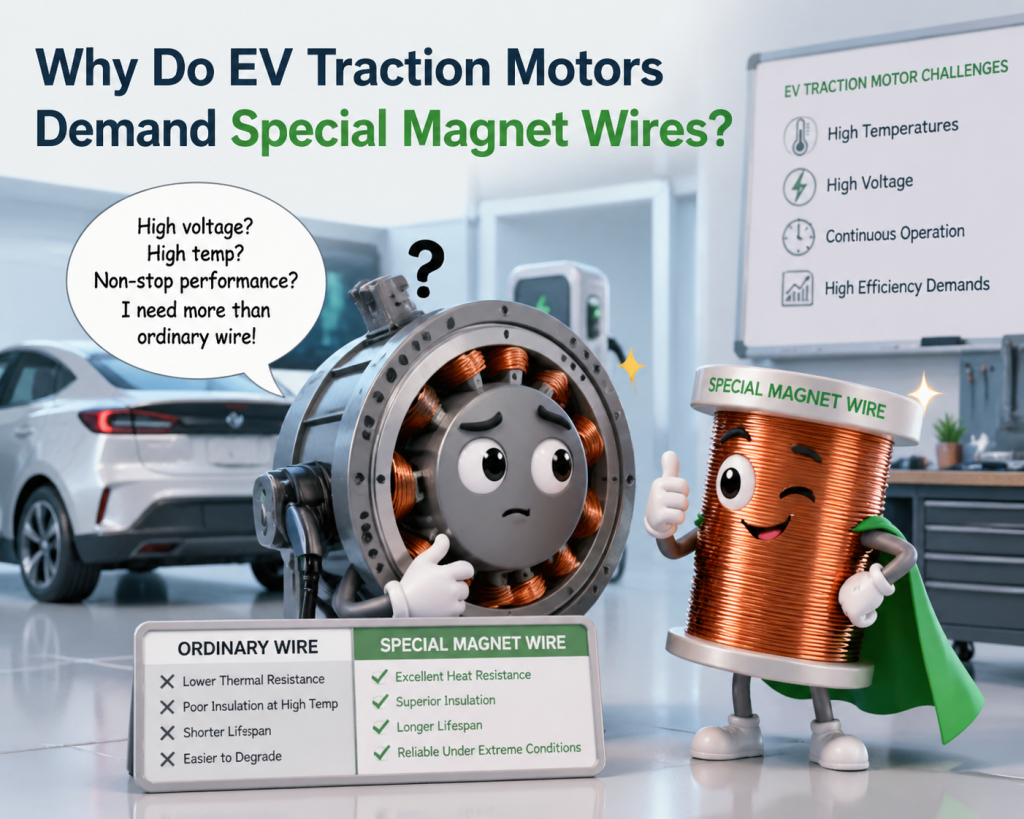
EV Traction Motors and Industrial Motors belong to the same category of electric motors and share the same classification system and control theory and methodology, but the difference in their application scenarios determines the essential difference in their core performance requirements and magnet wire demand. Industrial motors take the stable completion of industrial production tasks as their core objective, while EV traction motors need to adapt to the complex conditions of automobile driving, to meet the frequent start-stop, fast dynamic response, low-speed constant torque operation, strong overload capacity, wide speed range and four-quadrant operation and other special needs, while also taking into account driving comfort, environmental adaptability and other unique requirements of the vehicle, these differences are directly transmitted to the magnet wire selection and design. These differences are directly transferred to the selection and design of magnet wires.
The Difference Between the Basic Requirements of Electric Vehicle Motors and Industrial Motors
The difference between the basic requirements of electric vehicle motors and industrial motors is significant in terms of size, operating environment, reliability, power density, cooling method, etc., compared to industrial motor drive systems, as follows:
Strict Volume and Weight Limitations
Since EV traction motors are vehicle-mounted devices, the volume and weight requirements are particularly prominent. Ordinary industrial motors have relatively loose volume and weight requirements, usually to meet industrial production goals as the first principle. Electric vehicles are different, the size and weight of the motor directly determines the vehicle’s power performance and driving experience, which in turn affects the competitiveness of the product. Therefore, the core difficulty of EV motors is to improve the volume power density and specific power, and the motors need to be smaller, lighter and more powerful.
Unique Torque Characteristics
EV traction motors need to provide ultra-high torque during startup or low-speed driving to ensure that the vehicle accelerates to the target speed as fast as possible; at the same time, they need to output sufficient power when driving at high speeds to ensure the vehicle’s high-speed cruising ability. Ordinary industrial motors do not require such a high dynamic response, the torque output is relatively smooth, and they only need to meet the regular power demand in industrial production.
Wide Speed Range
The maximum speed of EV traction motors can be up to 4 times of the base speed and above, at present, the mainstream passenger car electric program eliminate the multi-gear transmission, and only fixed gears are used, so the wider the speed range of the motor is, the better. For example, the maximum speed of Tesla Model S drive motor has exceeded 18,000 rpm, which poses a very high test to the stability of power electronic governor and magnet wire.
Full-Range Efficiency Requirements
Unlike pantograph-powered electric locomotives, electric vehicles rely on battery power, and their range is highly dependent on motor efficiency. For every 1% increase in motor efficiency, the range can be significantly improved. Therefore, the requirements for motor efficiency are extremely stringent, and it is necessary to maximize and optimize the use of every bit of energy and minimize energy loss.
High Reliability and Stability
EV traction motors are required to ensure high safety under various driving conditions, especially the failure modes should be controllable to avoid motor failures affecting the safety of vehicle driving and threatening the lives of drivers and passengers.
Low Noise Requirements
EV traction motors need to strictly control electromagnetic noise and audio noise, to meet the vehicle electromagnetic compatibility standards and driving comfort requirements, to provide a quiet driving environment for drivers and passengers; while industrial motors have relatively loose restrictions on noise and do not need to be adapted to the driving scene.
Reasonable Cost Control
Cost is the core challenge to the popularization of electric vehicles, so EV traction motors need to ensure performance under the premise of strict cost control, to achieve a balance between high performance and low cost, to promote the popularization of electric vehicles on a large scale.
The core indicators for evaluating the motor drive system mainly include: external characteristics (the relationship between maximum output torque and speed), constant power speed range, drive system efficiency distribution (not single condition efficiency, nor motor body or controller efficiency alone), drive system power density and torque density.
The Other Differences Between Electric Vehicle Motors and Industrial Motors
In addition to the basic performance requirements, EV traction motors and industrial motors in the actual application of the details of the differences are also very obvious, specifically reflected in eight aspects:
Package Size
EV traction motors have limited layout space and usually need to be customized according to specific models to fit the body space; industrial motors have a more relaxed installation space and can be packaged in standard packages to fit a variety of industrial application scenarios.
Working Environment
EV traction motors have a wide range of working temperature changes (-40~105℃), and the vibration of the vehicle driving process is intense, complex working conditions; conventional industrial motors have an ambient temperature of -15~40℃, mostly static application scenarios, less vibration, and a relatively stable environment, while the industrial special motors can be adapted to more extreme temperatures and vibration environments.
Reliability-Oriented
The high reliability of EV traction motors is mainly used to protect the lives of drivers and passengers, and avoid safety accidents caused by motor failure; the high reliability of industrial motors is mainly used to protect production efficiency, reduce production interruptions caused by motor failure, and reduce downtime losses.
Cooling Method
EV traction motors are small in size, high in power density, and the heat generated during operation is concentrated, so the mainstream adopts water/oil cooling method to dissipate the heat efficiently; high-power, high-power density industrial motors also adopt water/oil cooling, and conventional industrial motors are large in size and the heat is scattered, so the air-cooling method is adopted, and the cooling requirements are relatively loose.
Control Performance
EV traction motors need to realize precise torque control and better dynamic performance, in order to adapt to the vehicle driving in the acceleration, deceleration, turning and other complex conditions; industrial servo and high-precision inverter motors with excellent dynamic performance, conventional industrial motors mostly use inverter control, focusing on the need for smooth operation.
Power Density
EV traction motors have higher power density and need to output more power in a limited volume to meet vehicle power requirements; industrial motors have lower power density and do not need to pursue the ultimate volume and power balance.
Efficiency Requirements
EV traction motors need to maintain high efficiency in the full operating range, covering all driving conditions such as start-stop, low-speed, high-speed, etc., and maximizing the use of battery energy; industrial high-efficiency motors (IE4/IE5) also require high efficiency in the full range of conditions, and conventional industrial motors focus on the efficiency requirements of the rated operating point.
Cost-Effective
EV traction motors need to achieve a better balance between high performance and low cost, not only to meet the power and safety requirements of the vehicle, but also to control the cost to promote the popularization of electric vehicles, the cost-effective requirements of industrial motors are relatively conventional, and do not need to take into account the special constraints of the vehicle scenarios.
Why Standard Magnet Wire Fails in EV Motors
Conventional magnet wires are designed for industrial motors and other conventional scenarios, and their performance cannot be adapted to the harsh working conditions of EV traction motors, thus failing to meet the special needs of EV traction motors.
In order to achieve fast acceleration and good maneuverability, EV traction motors need to output high power, which requires magnet wires to adopt thinner and better insulation layers to improve insulation reliability and slot fullness, while standard magnet wires do not have sufficient insulation performance and thin-wall precision to withstand the electrical loads of high power densities, and are susceptible to faults such as insulation deterioration and breakdowns.
At the same time, in order to achieve high performance and energy saving goals, EV traction motors need to minimize energy loss, which requires the magnet wire resistance as small as possible. Although the standard industrial magnet wire is made of high-purity oxygen-free copper, it has shortcomings in corona insulation, vehicle-grade thermal cycling and other adaptability to on-board working conditions, which will cause energy waste and shorten the range of the vehicle.
In addition, high-frequency and high-voltage pulses are generated when EV traction motors are powered by inverters, which are prone to partial discharges and damage to the insulating varnish layer. Standard magnet wires have a low Partial Discharge Initiation Voltage (PDIV) and insufficient corona aging resistance, which makes it difficult for them to meet the requirements for long-lasting automotive regulations, especially after the popularization of 800V high-voltage architectures.
What Makes EV Magnet Wire “Special”?
What makes EV Magnet Wire “Special” for traction motors is its optimized performance, which provides special advantages that are unmatched by industry standard magnet wires, as reflected in the following aspects:
High Power Density
In order to meet the needs of EV rapid acceleration and good handling, the magnet wire for EV adopts a thin, high-performance insulation layer, which improves the slot fullness under the premise of guaranteeing the insulation strength and PDIV performance, and can effectively withstand the electrical stress brought about by the high power output, avoiding the breakdown of insulation and ensuring the stable operation of the motor, thus helping the motor realize a higher power density.
Excellent Electrical Efficiency
In order to achieve the goals of high performance and energy saving, the magnet wire for EV adopts high-purity oxygen-free copper as the conductor material, and the dimensional accuracy, surface finish and formability of the conductor have been optimized to provide excellent electrical conductivity, which can minimize the resistance and current loss, and improve the efficiency of the motor. The excellent current carrying capacity can meet the needs of EV traction motors to operate efficiently over the whole range, reduce energy waste and extend the vehicle range.
High PDIV
In response to the high-frequency pulses and partial discharges caused by the EV inverter power supply, the EV special magnet wire is specially designed to simultaneously increase the Partial Discharge Initiation Voltage (PDIV) and corona aging resistance life, which can effectively resist the erosion of voltage pulses and partial discharges, avoid the aging of insulating lacquer layer, prolong the service life of the motor, and ensure the motor to run stably in high-voltage working conditions.
Great Mechanical Strength
The magnet wire for EV adopts high-strength conductor material and insulation layer, which is processed by special technology and possesses great mechanical strength, abrasion resistance and insulation adhesion. It can withstand the composite physical stresses brought by severe vibration, continuous rotation and flat wire molding in the process of EV driving, and can effectively avoid the magnet wire from abrasion, breakage or short-circuit, so as to guarantee the long-term stable operation of the motor and reduce the risk of malfunctioning.
High-Temperature Resistance
In order to adapt to the high temperature environment caused by long-time continuous operation of EV traction motors, the magnet wires for EV are equipped with automotive-grade high-temperature resistance and excellent thermal cycle stability, which can withstand the high temperature of the motors during operation, avoiding the deterioration and failure of the insulating layer, and ensuring that the motors can work stably even under extreme working conditions. High temperature resistance and high reliability can also extend the service life of the magnet wire and improve the overall reliability of the motor.
Good Corrosion Resistance
The magnet wire for EV adopts a corrosion-resistant insulating varnish layer that is resistant to refrigerant, oil, humidity and heat, which can effectively resist corrosive factors such as humidity, lubricating oil, cooling medium, and so on, and maintain the structural integrity of the windings and electrical performance, thus prolonging the service life of the motor. In the complex vehicle environment of new energy vehicles, the excellent corrosion resistance can prevent the winding from corrosion due to changes in environmental media and humidity, and ensure the long-term stable operation of the motor.
Meeting Space Constraints
The body design of electric vehicles requires high compactness and light weight of motors. Magnet wires for EV are commonly used in the design of rectangular (flat wire), which has a much higher fill rate than traditional round wires, and can accommodate more copper conductors in the same motor volume, which not only enhances the power density of the motor, but also reduces the volume and weight of the motor, and is perfectly adapted to meet the space constraints of the vehicle. Flat wires have been used in industrial high-end motors, and have been popularized in the EV field on a large scale.
How to Choose the Right Magnet Wire for EV Motors
When choosing the right magnet wire for EV traction motors, we need to take into account the working conditions of the motor, performance requirements and industry standards, and focus on the following 9 core dimensions to ensure that the magnet wire is suitable for the motor, and to guarantee the performance and service life of the motor:
Temperature Rating
When an electric vehicle is in operation, its electrical components generate a lot of heat, especially the EV traction motor, so it is necessary to select magnet wire with a temperature rating that matches the expected operating temperature of the motor. The right temperature rating prevents insulation deterioration and motor failure due to overheating, and ensures that the magnet wire works stably under the high temperature environment of long-term motor operation.
Conductor Specification
Conductor specification is the key index to determine the current carrying capacity of magnet wires, round wires refer to the wire diameter, flat wires are selected according to the dimensions of width × height. According to the rated current and power requirements of EV traction motors, it is necessary to select the appropriate specification to ensure that it can withstand the expected electrical loads, and avoid overheating of the windings and excessive voltage drop due to too small a conductor cross-section, or waste of volume and increase in cost due to too large a cross-section.
Voltage Rating
The power system of electric vehicles (especially the 800V high-voltage architecture models) operates at a high voltage, so when selecting magnet wire, we need to ensure that its voltage rating, PDIV and corona resistance exceeds the maximum working voltage of the motor to prevent electrical arcing, insulation breakdown and other problems, and to ensure that the motor runs stably under high-voltage conditions to avoid potential safety hazards.
Copper Quality
Copper is the core conductor material of magnet wire, and its excellent conductivity is the key to ensure low resistance and low loss of magnet wire. Therefore, when selecting magnet wires, it is necessary to ensure that they are made of high-quality, high-purity oxygen-free copper, in order to reduce the resistance and power loss, improve the efficiency of the motor, and at the same time, protect the mechanical properties and service life of the magnet wires.
Corrosion Resistance
During driving and parking, electric vehicles are exposed to humidity, cooling medium, lubricating oil and other harsh environmental factors, so it is necessary to choose magnet wires with good corrosion resistance. Priority is given to products with corrosion-resistant coatings or materials to ensure the optimal performance and durability of magnet wires, avoiding damage to the windings due to corrosion and prolonging the service life of the motor.
Wire’s Flexibility
During the driving process of electric vehicles, the components of traction motors will generate vibration and displacement, so the magnet wires need to have a certain degree of flexibility to withstand the stress brought about by these vibrations and displacements to avoid breakage or internal damage. Choosing magnet wire with high flexibility, durability and reliability can reduce the risk of motor failure and ensure the long-term stable operation of the motor.
Insulation Material
The thermal and electrical properties of insulating materials vary depending on the type. When selecting magnet wire, the working conditions of the motor should be combined with the consideration of the wear resistance, chemical corrosion resistance and adaptability to humidity and other environmental factors of the insulating material. Currently, the insulating materials commonly used for magnet wires include polyester, polyamideimide, polyimide and polyurethane, etc., which should be selected reasonably according to the needs of the motor.
Compliance
Compliance is the key to ensuring the safety, quality and compatibility of magnet wires. When selecting magnet wires, do not overlook whether they comply with the relevant standards and regulations of the automotive industry. You need to focus on checking whether the magnet wire complies with the relevant industry standards for electric vehicle electrical components, to ensure that it meets the standards in terms of temperature resistance, voltage resistance, mechanical strength, etc., and to avoid the safety hazards of choosing non-automotive-grade products.
Supplier Credibility and Reputation
Supplier credibility and strength directly determine the quality and after-sales service of the magnet wire. When choosing the magnet wire for EV traction motors, we should give priority to suppliers with mature application cases and good reputation in the automotive industry, especially those with automotive-grade production qualification, core technology and stable production capacity. The credibility of the supplier can be assessed through its product certification, customer cases, warranty policy, after-sales technical support, etc., to ensure that the quality of magnet wire is stable, and at the same time, timely technical support and after-sales protection can be obtained in the event of problems, so as to minimize the risks of procurement and use.
Where EV Magnet Wire Is Heading
With the rapid development of the electric vehicle industry, the market demand for high-efficiency, high-power density and high-reliability traction motors continues to rise, which also pushes the EV magnet wire industry to break into new fields. In order to meet the extreme performance requirements of EV traction motors, motor manufacturers are increasingly demanding advanced magnet wire solutions that can withstand extreme operating conditions and enable more compact and powerful designs for motors, and the EV magnet wire industry will move towards high-end, high-efficiency and specialization in the future.
Rectangular Flat Wires Become Mainstream
The transition from traditional round wires to rectangular flat wires is a core trend in the EV magnet wire industry. The filling rate of rectangular flat wire in the motor winding space is much higher than that of traditional round wire, which can encapsulate more copper conductors in the same volume, thus enhancing the motor power density and efficiency. It is especially suitable for high power density EV traction motors, which can realize a more compact and powerful design of motors, and it has been widely used in all kinds of electric vehicle traction motors.
Iteration of High-Temperature and Low-Loss Materials
EV traction motors run under the harsh working conditions of high temperature, high voltage, and high dv/dt pulses, which has pushed the magnet wire insulating materials to upgrade to higher temperature levels, lower loss, high-frequency pulse resistance, and corona resistance. At present, the industry is focusing on the demand for high-voltage structures of 800V and above, and is actively developing high-temperature and high-voltage-resistant insulating materials and coatings, which can effectively withstand higher temperatures and voltages, reduce insulation losses and energy wastage, and at the same time prolong the service life of magnet wires to meet the demand for high-voltage EV traction motors.
Growing Demand for Copper
Although the industry has been exploring alternative materials, copper, with its excellent electrical conductivity and mechanical properties, is still the dominant material for EV magnet wires and is indispensable for high-performance EV traction motors, and will continue to be used as a core conductor material in the future.
Conclusion
The difference in application scenarios between EV traction motors and industrial motors determines the essential difference in the performance requirements for magnet wires. standard industrial magnet wires are unable to meet the stringent requirements of EV traction motors in terms of high power density, high reliability, wide speed range, automotive-grade and long-lasting operation, etc. The EV-specific magnet wires have a high PDIV and high performance through targeted optimization of the insulating layer, conductor material, structural design, etc. The magnet wires have the advantages of high PDIV and high reliability. Through the optimization of insulation layer, conductor material and structural design, the magnet wire for EV is equipped with core advantages such as high PDIV, high corona resistance, high mechanical strength, high temperature resistance and corrosion resistance, which can be perfectly adapted to the complex working conditions of EV traction motors while taking into account the efficiency of the motor and the limitation of the space on board, and it is the core supporting component for EV to realize high-performance, long-range and high-safety.