In the field of electrical industry, enameled wire and copper wire are widely used basic conductive materials, both of which are based on copper as the core substrate, but due to different structural design, process processing, the formation of a very different performance characteristics and application scenarios.
What is electromagnetic wire
Enameled wire, also known as winding line, is a special conductive wire coated with an insulating lacquer layer, the core substrate is mostly high-purity copper, a few scenes will use aluminum as an alternative substrate. Its nature is a special wire for electromagnetic energy conversion, after winding into a coil and energized, it can stably generate an electromagnetic field, to achieve the mutual conversion between electrical energy and mechanical energy, magnetic energy.
The enamel layer of enameled wire is cured at a high temperature to form a uniform, dense insulating protective film. This structure allows it to be wound densely in a narrow space without the need for additional insulating compartments, and it is the core material for electromagnetic equipment such as motors and transformers.
What is copper wire
Copper wire is usually referred to as a linear conductive material made of industrial pure copper (copper violet / electrolytic copper), which is a rose-red color in its raw form, and a purplish-red color after the formation of an oxidized copper film on its surface, and is therefore also known as copper violet wire. Its production is subject to fire refining or electrolytic refining, electrolytic refining of copper wire purity of up to 99.95% -99.99%, is currently second only to silver conductivity of the metal material.
Copper wire used in the electrical industry requires oxygen-free copper, phosphorus, aluminum, lead and other impurities in the content is very low, to avoid impurities to reduce the conductive properties or lead to the material hot brittle. The density of copper wire is 8-9g/cm³, the melting point is as high as 1083 ℃, both excellent electrical conductivity, thermal conductivity and plasticity, can be made into a variety of forms of wire, rods, tubes, foils and other forms of cold pressed, hot pressed processing, is the basic material for power transmission, electrical wiring. Every year, more than 50% of the world’s electrolytic pure copper is used to manufacture various types of copper wires and copper conductive components.
Insulation
The core insulation of enameled wire is characterized by thin and uniform, using polyurethane, polyester, polyesterimide, polyimide and other special insulating varnish as the coating, the thickness of the varnish layer is accurately controlled at the micron level, and some of the high-end enameled wires will also adopt nano-composite shielding structure or multi-layer insulation coating process to improve corona resistance and anti-impact performance.
The core purpose of this thin insulation design is to maximize the winding density, while the enamel layer can be quickly removed by burning, solvent immersion, etc., to facilitate the coil terminal welding. Enameled wire insulation has no mechanical protection and is designed only for electrical isolation needs within electromagnetic devices.
Copper wire insulation is divided into two forms: bare wire and polymer sheathed insulation. Copper wire insulation commonly used in industry and home furnishings uses flexible polymers such as PVC, polyethylene, cross-linked polyethylene, Teflon, etc., as the sheath, and the thickness of the insulation layer is much thicker than that of enameled wires, ranging from a few millimeters to several centimeters depending on the voltage level.
Copper wire insulation to mechanical protection + electrical isolation as the core, can resist external friction, extrusion, corrosion, to adapt to complex installation environments, some of the sheath will also be added to flame retardant, anti-aging components, to meet the safety requirements of the building, outdoor wiring. Bare copper wire is mainly used for grounding, busbar and other scenarios that do not require insulation.
Shape and Finished Design
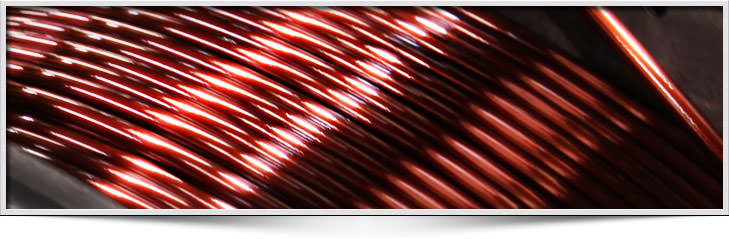
Enameled wires are mainly single-core conductors, which are divided into AWG (American gauge), SWG (British gauge) and other gauges according to wire diameter specifications, and also divided into models according to heat-resistant grade, and the finished products are mostly supplied on spools, which is convenient for direct coil winding. Some of the enameled wires for frequency conversion motors and new energy vehicle drive motors are also made into flat shape, with slot fullness rate of over 75% – 90%, which significantly increases the power density of the equipment.
The conductor surface of enameled wire has no additional treatment, keeping the pure copper in its native state, which ensures a stable bond between the lacquer layer and the conductor during the winding process.
Copper wire is available in a variety of forms, including single-core hard wire, multi-core soft wire, tinned wire, braided wire, etc. Single-core hard wire is suitable for fixed wiring, multi-core soft wire is suitable for bending and moving equipment wiring, tinned copper wire improves oxidation resistance, and braided copper wire is mainly used for electromagnetic shielding and grounding protection.
The finished form of copper wire covers single conductor, multi-core cable, row of wires, etc., wire diameter specifications according to square millimeter division, from 1.5mm² lighting line to 6mm² above the high-power equipment line, to meet the current-carrying needs of different scenarios, part of the multi-core cable will also add shielding layer, filler layer, to enhance the anti-interference and mechanical strength.
the performance of enameled wire vs. copper wire
Enameled wire heat-resistant grade after accurate design, according to national standards can be divided into 130 ℃, 155 ℃, 180 ℃, 200 ℃, 220 ℃ and other levels, polyimide enameled wire can even withstand short-term overload high temperature, to meet the electromagnetic equipment coils work when the local high temperature requirements.
Its heat-resistant design matches the insulating varnish material, such as 180 grade polyesterimide enameled wire with thermal shock temperature of at least 200℃, which can adapt to the temperature fluctuation brought about by frequent starting and stopping of motors and sudden change of load. The voltage adaptation of the enameled wire is based on low-voltage and high-frequency, focusing on improving the breakdown voltage, reducing high-frequency loss, and adapting to the high electric field strength environment inside the coil.
The heat resistance rating of copper wire is primarily determined by its external insulating sheath. For standard residential and industrial applications, the maximum operating temperature of copper wire typically ranges from 70°C to 90°C. Copper wire boasts an exceptionally wide voltage adaptability range: specialized products are available to accommodate everything from standard residential-grade 220V circuits to the thousands of volts (kilovolt-level) required for high-voltage transmission lines. The core design philosophy behind these products centers on minimizing line resistance, thereby reducing energy loss during long-distance power transmission.
Electromagnetic Adaptation vs Basic Conductivity
The performance of enameled wire is centered around coil winding and electromagnetic conversion, and four core properties are indispensable: mechanical properties: the enamel layer needs to have good elasticity, flexibility and scratch resistance.
Flexibility and scratch resistance: able to withstand the winding process of stretching, bending, friction;
Electrical properties: the paint layer needs to be pinhole-free, full coverage, high breakdown voltage, high-frequency high-voltage loss angle tangent value is small;
Thermal properties: need to meet the requirements of heat-resistant grade, with excellent thermal aging, thermal shock performance; chemical properties, the enamel layer needs to be resistant to acid, alkali, salt, organic solvents corrosion, to adapt to the complex environment within the equipment.
In addition, high-end enameled wire will also strengthen the corona resistance performance, to withstand the impact of high-frequency pulse voltage inverter motor, its corona resistance life than ordinary enameled wire to enhance 5-100 times.
The performance of copper wire to the basic conductive and mechanical processing as the core, the core indicators include:
Conductivity: to 20 ℃ 1m long, 1mm ² cross-sectional area of soft copper wire resistance 0.017241Ω for 100% of the benchmark, the larger the resistance, the lower the conductivity;
Bending resistance: a measure of the resistance to fracture of copper wire repeated bending, soft copper wire bending resistance is much better than hard copper wire; tensile strength and tensile strength, to determine the load-bearing and tensile strength of copper wire;
Elongation: reflecting the plasticity of copper wire, to ensure that the process is not easy to break.
The conductivity of copper wire is significantly affected by temperature, the temperature rises 1 ℃, the resistance increased by about 0.4%, so industrial applications need to consider temperature compensation.
the advantages and disadvantages of enameled wire VS copper wire
Advantages of enameled wire
A: high winding density, thin insulation layer allows the coil can be in a small space intensive winding, enhance equipment miniaturization, lightweight level;
Two: high electromagnetic conversion efficiency, special insulating varnish layer to reduce high-frequency loss, reduce energy waste; three: excellent heat resistance, corona resistance, can adapt to the harsh working environment of the electromagnetic equipment, to extend the service life of the equipment;
Four: welding is convenient, the paint layer can be quickly removed, without additional stripping process, to enhance production efficiency.
In addition, the enameled wire has good chemical stability, can resist the oil mist and solvent corrosion inside the equipment, suitable for long-term continuous work.
Disadvantages of enameled wire:
First: poor mechanical protection: the paint layer is susceptible to external scratches, breakage, can not be used alone in the outdoor, humid, dusty environment, must be encapsulated within the equipment;
Two: high cost: need to go through a number of complex processes such as annealing, painting, high-temperature curing, the production cost is 30% -50% higher than ordinary copper wire;
Third: a single application scenario, only for electromagnetic coil winding, can not replace the copper wire for power transmission, wiring;
Four: aluminum-based enameled wire, although lower cost, but poor conductivity, need to increase the cross-sectional area to meet the current-carrying requirements, will increase the volume of equipment.
Advantages of copper wire
The advantages of copper wire are reflected in the versatility and basic performance:
First: excellent conductivity, is currently the most cost-effective conductive materials, can minimize power transmission losses;
Two: good plasticity: easy to process, easy to install, can be made according to the needs of different forms, to adapt to various types of wiring and equipment wiring needs;
Three: good mechanical strength and protection: insulation sheath can resist external friction, extrusion, bare copper wire can be directly grounded, convergence;
Four: strong corrosion resistance: pure copper in a dry environment is not easy to oxidize, tinned copper wire, corrosion-resistant sheathed copper wire can also be adapted to humid, outdoor environment;
Five: high recycling rate: copper can be 100% recycled and no loss of performance, in line with environmental requirements.
Disadvantages of copper wire:
A: can not be directly wound electromagnetic coils, thick insulation layer leads to extremely low density winding, if the insulation layer is removed, there will be a short circuit between the coils, can not generate a stable electromagnetic field;
Two: weak resistance to electromagnetic interference, ordinary copper wire without special shielding design, long-distance transmission is susceptible to electromagnetic interference, resulting in signal attenuation;
Third: poor control of surge capacity, unable to adapt to the high frequency pulse voltage inside the electromagnetic equipment, prone to breakdown of the insulation layer;
Four: the cost of copper price fluctuations by the impact of high purity copper wire prices are much higher than aluminum wire and other alternative materials, and because of the high value, easy to be stolen.
The two can not replace each other
Enameled wire is a special wire for electromagnetic equipment, copper wire is a general-purpose wire for power transmission and electrical wiring, their design intent and performance focus is completely different, there is no possibility of mutual substitution. If you use copper wire instead of enameled wire winding coil, due to low winding density, insulation layer is not applicable to lead to a significant reduction in the efficiency of the equipment, and even short-circuit burn; if you use enameled wire for home wiring, outdoor transmission, due to the poor mechanical protection ability to lead to paint layer breakage, triggering electrocution, short-circuit and other safety accidents.
the enameled wire VS copper wire application areas
Enameled wire:
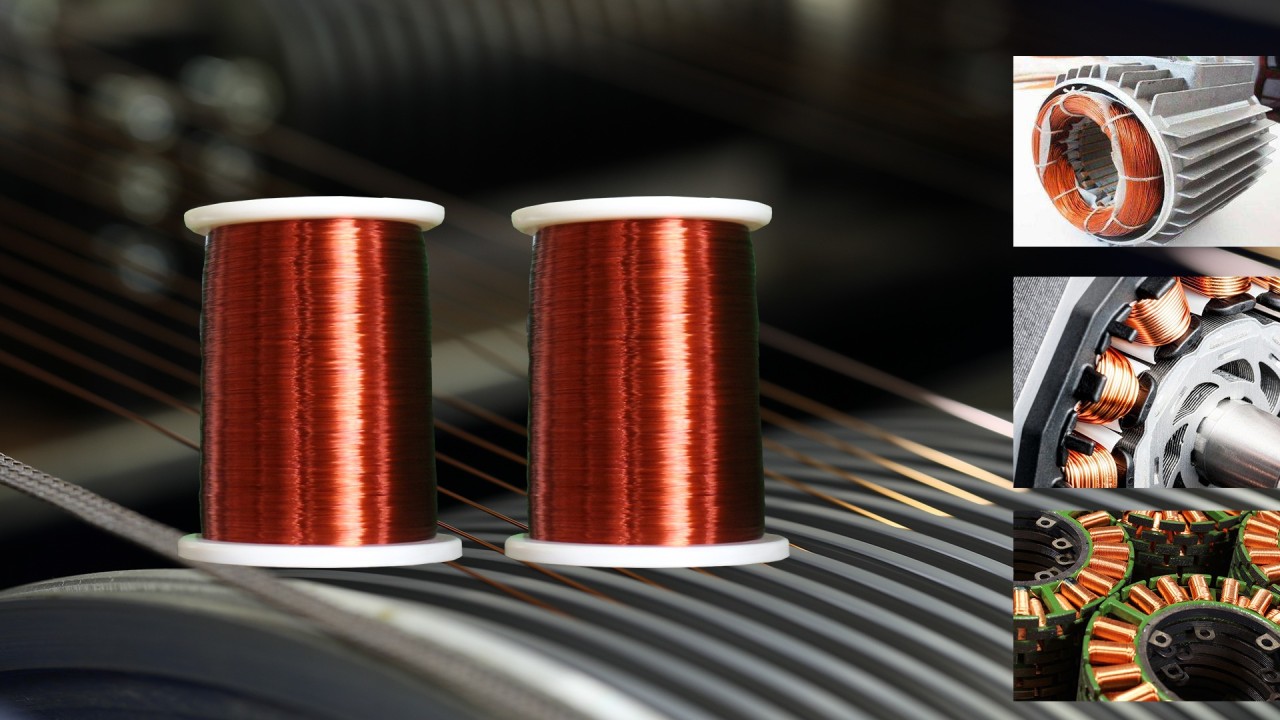
- motors and generators: industrial motors, inverter motors, new energy vehicle drive motors, generators, the core coils are wound with enameled wire, high-end motors will also use corona-resistant, flat-type special enameled wire, to enhance the efficiency and power density of the motor, used in conveyor systems, industrial robots, HVAC systems, power station turbines and other equipment.
- transformer: power grid, industrial control cabinets, new energy converter in the transformer, relying on enameled wire windings to achieve the voltage rise and fall and power transmission, low-loss enameled wire can reduce the heat loss of the transformer, improve energy efficiency.
- Electromagnetic control equipment: relays, solenoid valves, solenoids, electromagnetic clutches and other equipment, through the enameled wire coils to produce a precise electromagnetic field, to realize the conversion of electrical signals to mechanical action, used in industrial automation, security systems, mechanical equipment control and other fields.
- Welding equipment: Welding transformers and induction coils are made of high current and heat resistant enameled wire, which can work stably under high current load and ensure the precision of current control in the welding process, and are applied in scenarios such as machinery manufacturing, automobile production, and industrial maintenance.
- New energy systems: wind turbines, solar inverters, energy storage battery system in the core electromagnetic components, are used in enameled wire winding, its high efficiency, long life characteristics can enhance the overall performance of new energy equipment, reduce operation and maintenance costs.
- Small electronic equipment: inductors, transformers, micro-motors in electronic products such as computers, cell phones, TVs, game consoles, etc., use ultra-fine gauge enameled wire to meet the demand for miniaturization and lightweighting of equipment.
Copper wire:
- Civil and architectural wiring: lighting, sockets, high-power equipment wiring in home furnishings, and electrical wiring in commercial buildings and industrial plants, all of which use different sizes of insulated copper wires, such as 1.5mm² copper wires for lighting, 4mm² copper wires for air-conditioning, high-power equipment in kitchens. Copper wires are also used in the grounding system and lightning protection system of buildings to ensure the safety of electricity.
- Power transmission and distribution: from the power station to the substation of the high-voltage transmission lines, substation to the user of the low-voltage distribution lines, are used in large cross-sectional area of copper wire or copper-core cables, some of the high-voltage lines will also be used in the steel-core aluminum stranded composite copper wire, taking into account the electrical conductivity and mechanical strength.
- electronic and electrical equipment: all kinds of household appliances, industrial equipment, internal wiring, circuit board welding wire, are used in copper wire, tinned copper wire is also widely used in connectors, terminal blocks, to enhance oxidation resistance.
- Communications industry: telephone lines, DSL data lines, communication cables, the inner core of the copper wire, its good signal transmission ability to protect the stability of communication, part of the communication cable will also increase the shielding layer of copper wire, to enhance the anti-interference.
- Automotive industry: traditional fuel vehicles and new energy vehicles, vehicle wiring, battery connections, engine wiring, are used in multi-core soft copper wire, new energy vehicles, battery packs will also use a large cross-sectional area of copper rows, to ensure the stability of high-power power transmission.
- Renewable energy systems: solar photovoltaic panels, wind turbines, the internal wiring, new energy power station distribution lines, are using copper wire, its high conductivity can reduce the transmission loss of new energy power generation, and enhance the efficiency of energy utilization.
enameled wire and copper wire how to choose?
Enameled wire selection and use of key points
- Selection according to the heat-resistant grade and type of insulating varnish: according to the working temperature of the equipment to select the corresponding heat-resistant grade of enameled wire, such as frequency converter motors to choose 180 ℃ and above polyesterimide or polyimide enameled wire, and at the same time to confirm the type of insulating varnish enameled wire to match the working environment of the equipment, such as contact with organic solvents equipment need to choose solvent-resistant enameled wire.
- Match the wire gauge and current-carrying demand: according to the current size of the coil to choose the appropriate wire diameter enameled wire, high-current windings can choose a large wire diameter enameled wire, or the use of multiple enameled wires in parallel winding, to reduce the loss caused by the skin effect.
- standardize the winding and welding operation: avoid stretching and bending the enameled wire in the process of winding, to prevent the paint layer from breaking; before welding the terminal, the need to use burning, solvent soaking and other ways to completely remove the paint layer, to ensure that the welding is solid, but also can be used directly with the appropriate enameled wire enameled welded terminals, improve production efficiency.
- Do a good job of the internal protection of equipment: enameled wire wound into coils, need to be dipped in paint, encapsulation treatment, fill the air gap inside the coil, enhance the reliability of insulation and mechanical protection to prevent the paint layer due to vibration, high temperature fall off in the process of equipment operation.
- Match the wire diameter and type according to the application scenario: follow the principle of “bigger rather than smaller” for home wiring, use 1.5mm² copper wire for lighting circuits, 2.5mm² copper wire for ordinary sockets, and 4mm² and above copper wires for air-conditioning, kitchens, bathrooms, and other high-power areas; choose single-core hard copper wires for fixed wiring, and choose multi-core soft copper wires for wiring of equipments and mobile lines; choose multi-core soft copper wires for connecting and wiring of equipment. Choose single-core hard copper wires for fixed wiring, multi-core soft copper wires for equipment wiring and mobile lines, and braided copper wires for grounding and shielding.
- Recognize the national standard products to avoid quality hazards: choose copper wires printed with GB/T 5023-2008 and other national standards, check the color of the copper core is purple-red, glossy and uniform, and avoid purchasing non-standard products with blackened copper cores and substandard diameters. Insulation sheath should be flame retardant, anti-aging materials, outdoor wiring also need to increase the UV protection sheath.
- Standardize construction and installation: avoid excessive bending and squeezing of copper wires in the wiring process, and the number of wires in a single PVC wire pipe should not be more than 3 (2.5mm² copper wires), so as to prevent the high temperature in the wire pipe from accelerating the aging of the insulation layer; use the special terminal for the wiring to avoid false connection leading to heating, and use yellow and green copper wires in the grounding line, and prohibit the mixing with the zero line.
- Consider environmental factors for protection: humid, corrosive environment using tinned copper wire or corrosion-resistant copper wire, outdoor wiring need to increase the protection of the wire pipe to avoid direct exposure of copper wire in the air; high temperature environment, select high temperature resistant copper wire, and at the same time appropriate increase in wire diameter, to compensate for the increase in resistance to temperature.
summarize
Enameled wire and copper wire as the electrical industry, two core conductive materials, although sharing high-purity copper substrate, but due to the structural design and process processing of differentiation, the formation of a “specialization” and “generalization” of the stark contrast. Enameled wire is a special wire for electromagnetic energy conversion, with high winding density, excellent heat resistance and electromagnetic properties, to become the core material for motors, transformers and other electromagnetic equipment; copper wire is the basic material for power transmission and electrical wiring, with excellent conductivity, versatility, and mechanical protection, covering the whole scene from civil home furnishings to industrial production.
The two application areas do not overlap each other, can not replace each other, the core of the selection is based on the needs of the use of the scene, matching the performance characteristics of the material. In practice, enameled wire and copper wire are often used in conjunction with each other to form the conductive network of electrical equipment and power systems, such as the internal coil of the motor using enameled wire, and the external wiring of the motor using copper wire.
With the development of the electrical industry, enameled wire is towards high heat resistance, corona resistance, miniaturization of the direction of upgrading, copper wire is to enhance the conductive efficiency, cost reduction, environmental protection, recycling and other aspects of the continuous optimization, the two will continue to play an important role in their respective fields, for the upgrading of electrical equipment and the development of electric power systems to provide basic support.